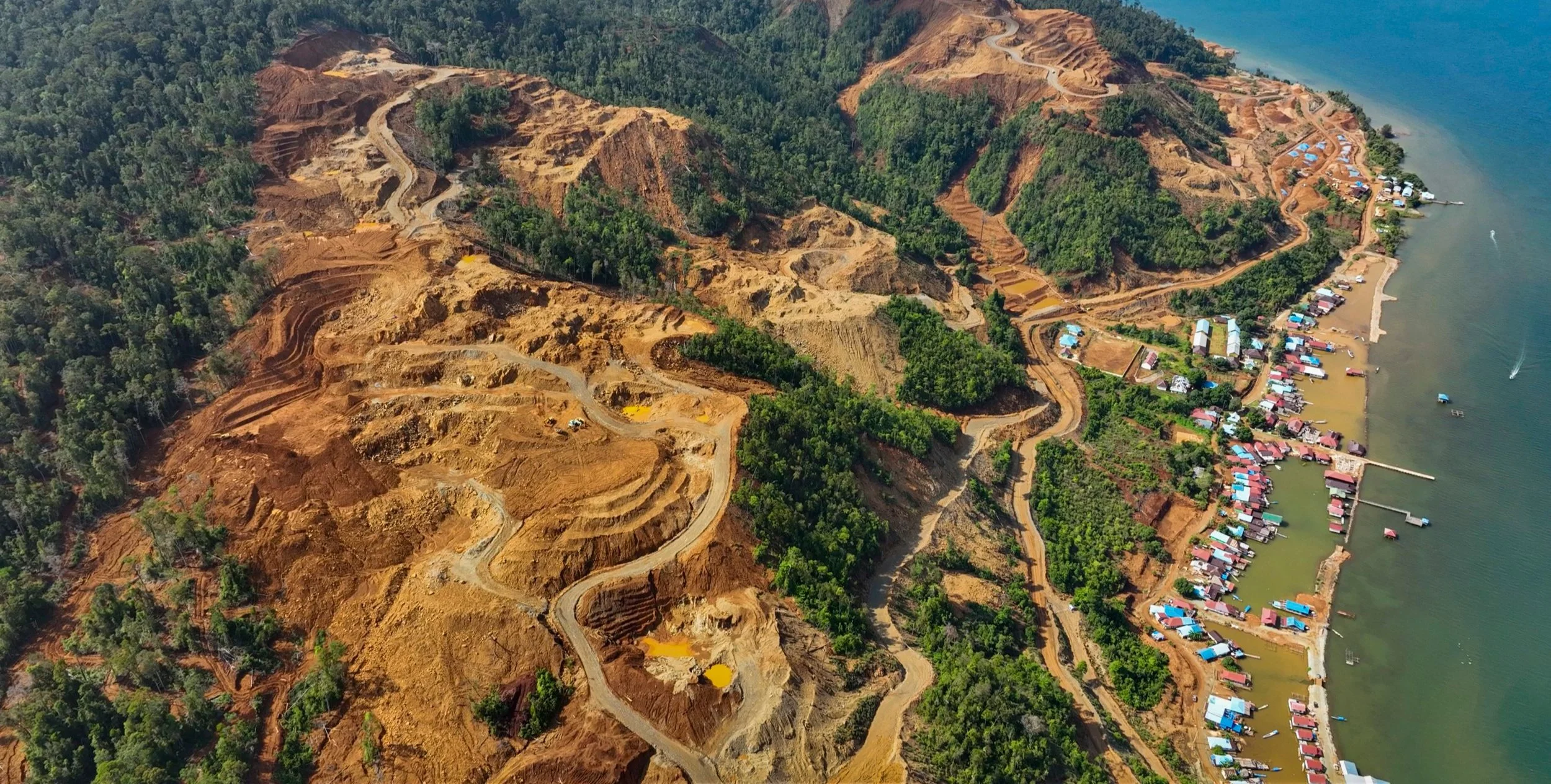
POPULATIONS AT RISK
Local populations are victims of land dispossession in many places across Indonesia. Often the cause is projects labeled "national priority" by the government in Jakarta. The nickel industry is no exception to this rule, leading to the relocation of entire villages to make way for mines and/or industrial complexes.
The best-known and most widely reported case is of course that of the Eramet and Tsingshan mining concession in Halmahera, where the 55,000-ha concession significantly encroaches on the ancestral lands of the Hongana Manyawa people. Survival International has denounced this as a genocidal situation.
NGOs such as WALHI and JATAM, which specialize more in supporting and providing legal aid to local populations, report numerous cases where local demands are ignored and projects are imposed without any consultation or public inquiry.
Communities poisoned by heavy metals from the mines
In Mandiodo Bay, also in Southeast Sulawesi, Bajau communities have seen fish become scarce and nearly disappear from their fishing grounds. The Bajau, a people of fishers par excellence, depend on marine resources for their survival. In this bay, the population now consumes large quantities of filter-feeding mollusks called "Lola" to make up for the disappearance of fish. However, Prof. La Ode Aslan (Halu Oleo University – Kendari) found abnormally high concentrations of cadmium in these shellfish [1]. Cadmium is classified as a "known carcinogen."

Former school on the Mandiodo mine site; the village was relocated a few kilometers away, where residents now live amid the mine's contaminated effluents. (Source: V. Romera - July 2024)

As part of the Indonesian Konawe Industrial Park (IKIP) project, entire villages find themselves within mining perimeters. In one of these villages, Walandawe, many residents are clearly opposed to nickel extraction in the area. No public inquiry has been carried out, even though the law normally requires one. Thoroughly disillusioned and left to fend for themselves by the authorities, residents have recently cleared large areas of forest to convert them into farmland, in an effort to fight back against the mines! Indeed, while mining companies have no trouble obtaining authorization to clear primary forests, even when classified as "protected forest," the residents of Walandawe hope it will prove harder for the mines to legally destroy farmland.

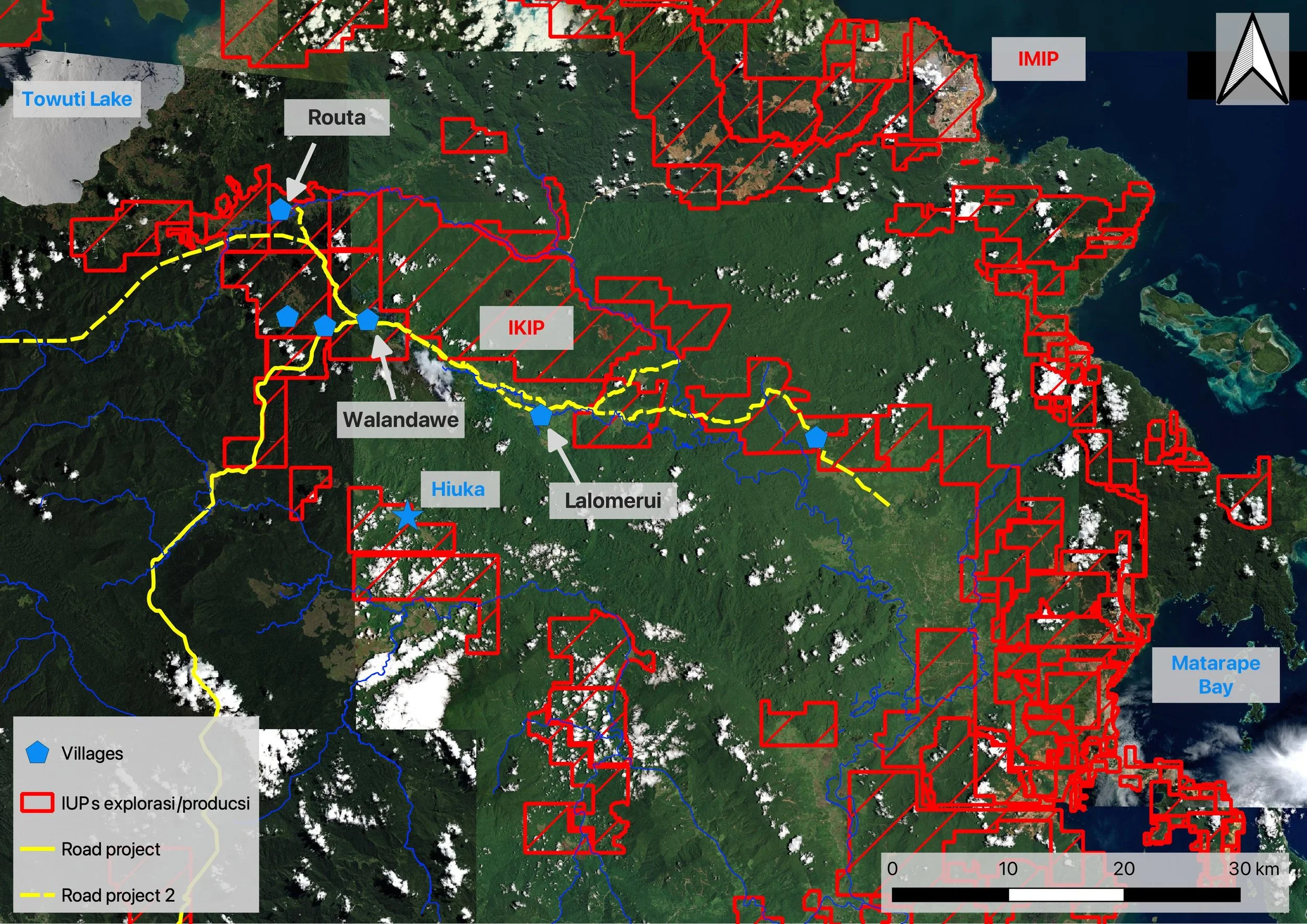
Ultramafic forest cleared to plant pepper trees, in the hope of slowing the establishment of a nickel mine. Map: in red, mining concessions authorized for exploration and production (IUPs). The explosion of mines in the north of Southeast Sulawesi province is accompanied by planned road networks to serve the concessions (in yellow). A wide track already exists linking the world's largest nickel processing complex, the Indonesian Morowali Industrial Park (IMIP), to the site under construction for the new nickel refining park: the Indonesian Konawe Industrial Park (IKIP). The rivers (in blue), Lake Towuti (a protected area), the temporary Hiuka lake, and Matarape Bay are all particularly sensitive ecosystems threatened with total destruction.
On the island of Kabaena, the NGO Satya Bumi revealed the concentrations of several heavy metals in the urine of the local population. Nickel concentration in the urine of Kabaena residents ranges between 4.77 and 36.07 µg/L, with an average of 16.65 µg/L. This value far exceeds normal levels found in the human population. In the United States, the average urinary nickel concentration in the population is 1.11 µg/L; in the major cities of Beijing and Shanghai, the median nickel level in the population is 3.63 µg/L. The population of Kabaena is therefore exposed to 5 to 30 times more nickel than average! [2]
These levels are comparable to those found in workers employed at nickel refineries.

A child plays in the contaminated sea at Kabaena. Source: Satya Bumi
Young children also show worrying creatinine levels in their urine. Elevated creatinine levels indicate an abnormal workload on the kidneys, explained by exposure to heavy metals, particularly cadmium.
Bajau children are believed to be especially affected, since they spend a great deal of time in the water.
Levels far exceeding median values were also detected for lead and zinc.
In the Philippines, the situation regarding nickel is no better. An assessment of heavy metal bioaccumulation in mollusks found in mangroves exposed to mining effluents shows that heavy metal concentrations exceed thresholds by 182% for nickel, 685% for copper, and 234% for chromium [3].
Another impact study conducted in the Philippines reveals high concentrations of nickel and chromium in sediments, as well as strong accumulation of nickel, iron, and chromium in clams [4]. Alarmingly, the assessment also indicates that heavy metal accumulation in rice grains from paddies irrigated with mining-contaminated water exceeded safety levels.

The Obsidian Stainless Steel (OSS) plant, in Morosi (Konawe - Southeast Sulawesi), produces stainless steel and "nickel matte," a material used in battery production. To give a sense of scale, the heavy coal storage tunnel (coal being used as a reagent in refining) is nearly 470 m long. The grayish deposits visible in the lower left of the photo (and also seen scattered elsewhere) are blast furnace waste known as "slag." Here it is being used to fill in the wetland on which the plant is built. Surface water in the area ranges in color from reddish-brown to deep black… The houses in the lower right of the image belong to fishers and farmers; people continue to raise fish and shrimp in the visible ponds and to grow rice and other crops. (Source: V. Romera - HUMY NGO)
Références :
https://mongabay.co.id/2024/05/13/jejak-logam-berat-tambang-nikel-di-perairan-sulawesi-tenggara/
https://satyabumi.org/melacak-jejak-eksploitasi-tambang-nikel-melalui-urin-warga-kabaena/
Marbella, K. (2020). Heavy metal accumulation in molluscs as bioindicator of contamination in mangrove sediments in Lake Uacon, Candelaria, Zambales. Archīum Ateneo. https://archium.ateneo.edu/theses-dissertations/508/
Juganas, D., Abella, G.P, Sigua, G., Valera, M., Morales, E., Santos, L.M., et Villen, J.W. (2022). Rapport final : Impact Assessment of Mining Activity in Candelaria, Zambales, Philippines (Wet Season).